# Back Up an Exoscale Managed MySQL Database
This guide backs up an Exoscale Managed MySQL database using `mysqldump` streamed through Plakar to Exoscale Object Storage (SOS). The result is an encrypted, deduplicated snapshot stored separately from your database infrastructure.
## Architecture
{{< mermaid >}}
flowchart TB
subgraph Client["Backup Client"]
MySQLDump["mysqldump"]
Plakar["Plakar
stdin integration"]
end
subgraph DB["Exoscale Managed MySQL"]
MySQL["MySQL"]
end
subgraph Storage["Exoscale Object Storage"]
SOS["Kloset Store
(Encrypted & Deduplicated)"]
end
MySQL -->|SQL dump| MySQLDump
MySQLDump -->|stdin| Plakar
Plakar -->|Snapshots| SOS
{{< /mermaid >}}
## Prerequisites
- Exoscale account with billing configured
## Create MySQL Database
### Provision database
1. Log in to Exoscale Portal
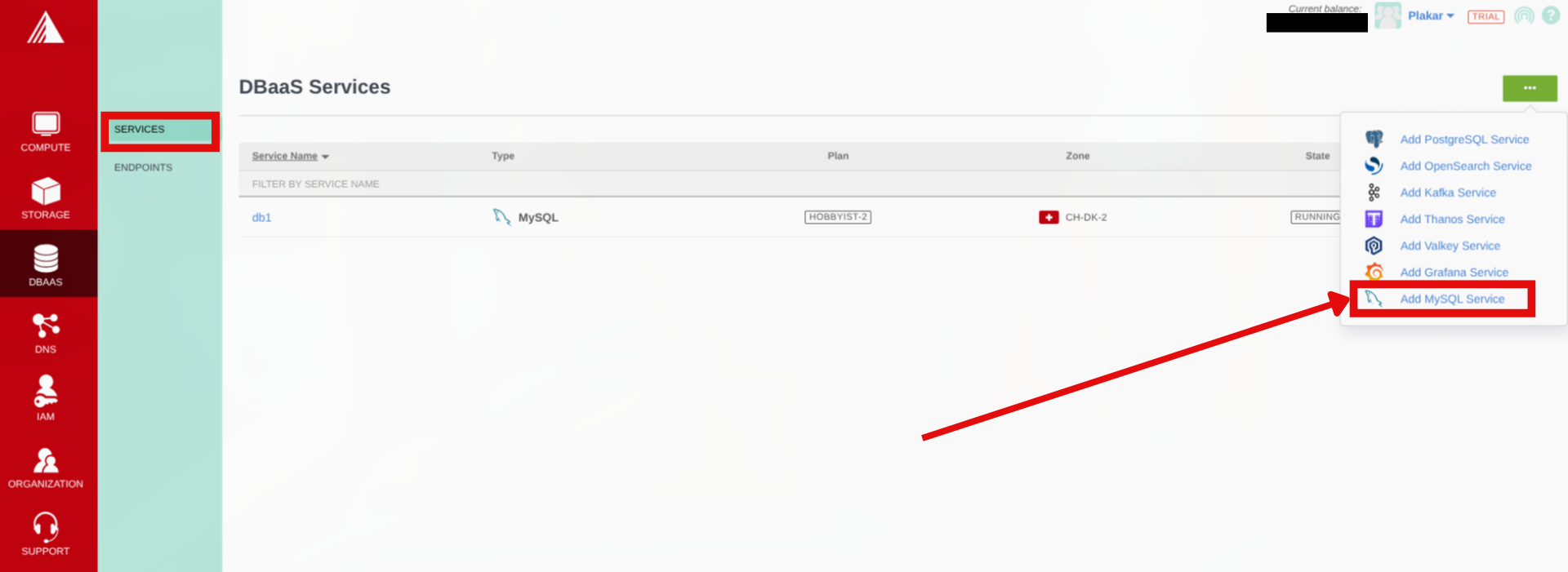
2. Go to **DBAAS** → **Services**
3. Click on the button with an ellipsis icon then select **Add MySQL Service** from the dropdown
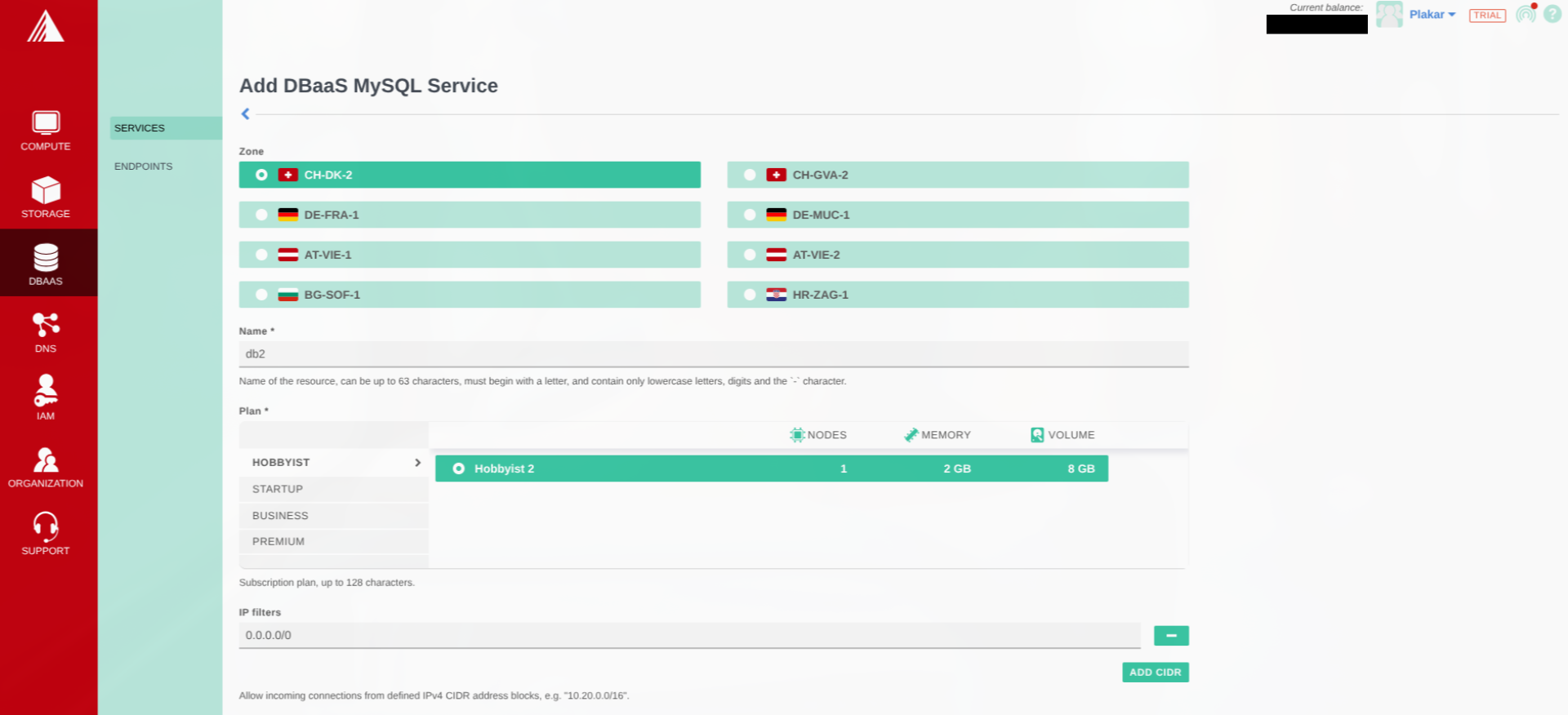
4. Configure:
- Zone: Select location
- Database name
- Plan: Select instance size
- IP Filters, click on **Add CIDR** and enter your IP address to access the database or use `0.0.0.0/0` to access it from any IP
5. Click **Add**
### Download connection details
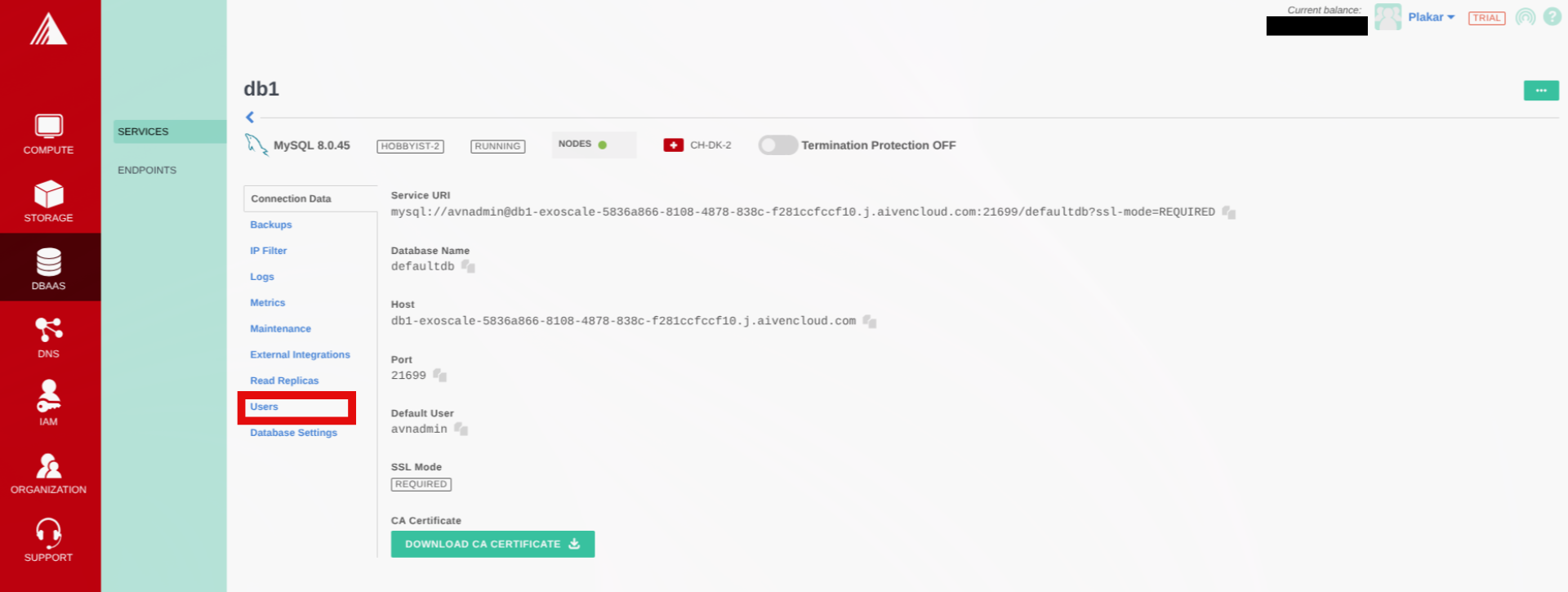
1. In the database connection data tab, download your CA Certificates and get the other connection details.
2. In the users tab, save your database user password
## Install Tools
Install MySQL client:
```bash
$ sudo apt update
$ sudo apt install mysql-client
```
Install Plakar using the [installation guide](../../../quickstart/installation).
## Configure MySQL Connection
Set environment variables from connection details:
```bash
$ export MYSQL_HOST=
$ export MYSQL_TCP_PORT=21699
$ export MYSQL_USER=
$ export MYSQL_PWD=
```
Configure SSL/TLS with CA certificate:
```bash
# Place CA certificate in a secure location
$ sudo mkdir -p /etc/mysql/certs
$ sudo cp ca.pem /etc/mysql/certs/
$ sudo chmod 644 /etc/mysql/certs/ca.pem
```
Create MySQL configuration file:
```bash
$ cat > ~/.my.cnf << 'EOF'
[client]
ssl-ca=/etc/mysql/certs/ca.pem
ssl-mode=REQUIRED
EOF
$ chmod 600 ~/.my.cnf
```
Test connection:
```bash
$ mysql -e "SELECT VERSION();"
```
## Configure Object Storage
### Install S3 integration
```bash
$ plakar login -email you@example.com
$ plakar pkg add s3
```
### Create Object Storage bucket
If not already configured, follow: [Exoscale Object Storage setup](../exoscale-compute-as-a-dedicated-backup-server/#configure-object-storage)
### Add storage connector
```bash
$ plakar store add exoscale-sos-mysql \
location=s3:/// \
access_key= \
secret_access_key= \
use_tls=true
```
Replace:
- ``: e.g., `sos-ch-dk-2.exo.io`
- ``: e.g., `plakar-backups`
- `` and ``: From Exoscale IAM
### Initialize store
```bash
$ plakar at "@exoscale-sos-mysql" create
```
## Back Up Database
```bash
$ mysqldump --single-transaction \
--routines \
--triggers \
--events \
| plakar at "@exoscale-sos-mysql" backup stdin:dump.sql
```
Verify:
```bash
$ plakar at "@exoscale-sos-mysql" ls
```
## Restore Database
Retrieve snapshot ID:
```bash
$ plakar at "@exoscale-sos-mysql" ls
```
### Restore single database
```bash
$ plakar at "@exoscale-sos-mysql" cat :dump.sql | mysql
```
## Troubleshooting
**Connection refused**
- Verify `MYSQL_HOST`, `MYSQL_TCP_PORT`, `MYSQL_USER`, `MYSQL_PWD` environment variables
- Check database is running in Exoscale Portal
- Verify network access/firewall rules
**Authentication failed**
- Confirm user credentials
**S3 upload errors**
- Check S3 credentials: `plakar store show exoscale-sos-mysql`
- Verify endpoint URL and bucket name
- Confirm bucket exists in Exoscale Portal
**mysqldump not found**
- Install MySQL client: `sudo apt install mysql-client`